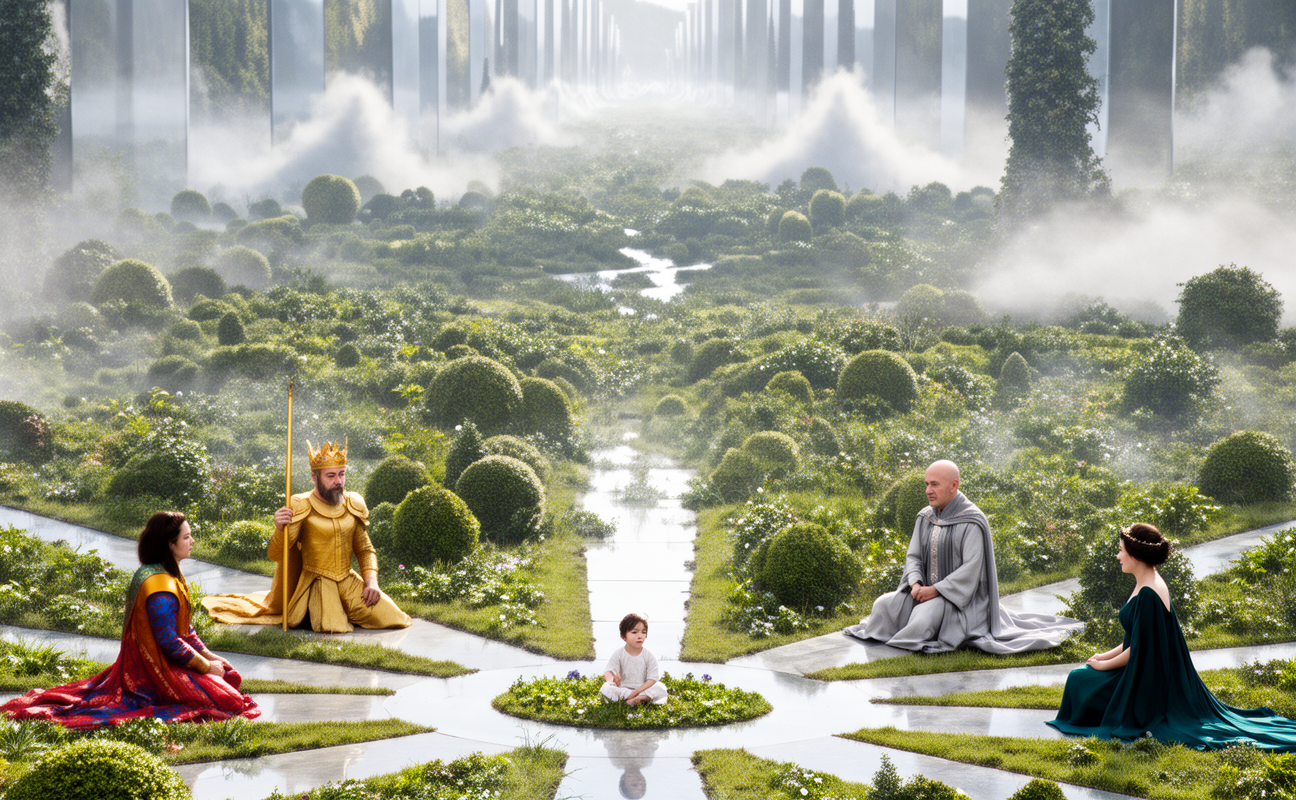
In the Valley of Mirrors, where every thought cast a reflection and every reflection believed itself real, five ancient figures wandered the land, each carrying a fragment of truth.
The Emperor built straight roads and tall towers. “Only what stands firm can be trusted,” he declared.
The Empress planted gardens in the cracks his roads made. “Only what grows can be trusted,” she whispered.
The High Priestess moved through the mist. “Only what is felt can be trusted,” she murmured.
The Magician spun shimmering stories from the fog. “Everything can be trusted,” he laughed, “if you can make others believe it.”
The Hierophant clutched his scrolls. “We must choose one truth, one path, one order,” he insisted.
Their voices echoed across the valley, each insisting on their reflection. Roads cracked. Gardens tangled. Fog thickened. Illusions multiplied. Scrolls contradicted themselves.
And then a sixth figure appeared.
He did not shout. He did not build. He did not plant. He did not reveal. He did not teach.
He simply smiled.
Chains hung loosely from his hands - so loose they looked like jewellery. He whispered:
“You are free. Free to choose. Free to desire. Free to chase whatever reflection you like.”
And the mirrors brightened at his words, each one offering a different promise. People rushed toward the reflections, believing they were choosing freely, not noticing the chains tightening with every step.
The Emperor’s roads grew faster. The Empress’s gardens grew thinner. The High Priestess’s mist grew heavier. The Magician’s illusions grew louder. The Hierophant’s scrolls grew brittle.
The valley shimmered with choice, but the people were no longer choosing.
They were being chosen. The Tower in the centre of it all was collapsing.
One day, a child entered the valley - not an archetype, but a living being. She watched the six figures and the restless mirrors. Then she sat down in the centre of the valley and simply breathed.
The mirrors stilled.
The chains loosened.
The Devil’s smile faded - not in anger, but in recognition. His glamour dissolved in the quiet.
The Emperor lowered his sword. The Empress untangled her vines. The High Priestess let the fog settle. The Magician paused his illusions. The Hierophant closed his scrolls.
The Devil stepped forward, bowed to the child, and said:
“You have seen through the mirror. My work here is done.”
And he vanished like smoke.
The five remaining figures sat together for the first time. Not in agreement, but in conversation. Not in unity, but in wholeness.
And the Valley of Mirrors, freed from glamour, began to reflect the world as it truly was - alive, relational, and ready to be re‑imagined.
Reflection.
The Devil in this parable is not evil. He is the archetype of false freedom - the glamour of choice that hides captivity.
This is the shadow of neoliberalisation:
freedom without relationship
choice without meaning
desire without context
acceleration without direction
The child represents the emergence of a worldview that sees through the glamour - the beginning of coagula after solve, the integration of structure, care, intuition, narrative, and shared meaning.